Ample studies are required to determine where to allocate K-B Joint in columns, beams, and walls in structures such as treatment plants, tunnels, and hollow bridge abutments.
Nihonkasetsu Corporation shall meet your demandsin crack control by suggesting K-B Joint allocationwhich is the most suitable for your structures.
Technical support can be provided on demand, as we have a consulting agreement with C&R ConsultantCo., Ltd.
◆
Research and audit for concrete structures.
◆
Study and planning for crack control.
◆
Investigation for cause of cracks, planning for repair work and reinforcement work.
◆
Exfoliation test on concrete using an infrared camera.
etc・・・
Experts on concrete
structures
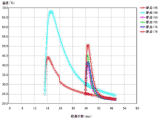
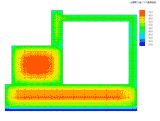
◆ Thermal Stress Analysis ◆
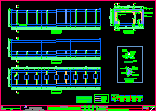
◆ Distribution drawings ◆
◆Consulting over 100 cases per year.
◆Distribution drawings available in AutoCAD
K-B Joint allocation and study based on your site condition can be provided. (Extra charge)
(Excerpt from Standard Specification for Concrete Structures)
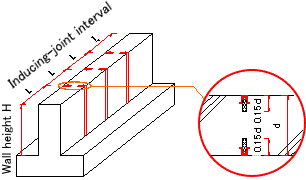
When a crack-inducing joint is used in order to control crack formation, its structure and position must be determined, so that strength and function of the structure is not affected.
◆ Description ◆
In concrete structures, deformation sometimes occurs due to other causes than external force, such as heat of hydration in cement, changes in temperature, and drying shrinkage. When such deformation is constrained, it can result in formation of cracks. Therefore, it is effective to make sectional-area voids at predetermined intervals and to provide crack-inducing joint to artificially generate cracks, so that formation of cracks can be concentrated within the predetermined area. Upon provision of crack-inducing joint, sufficient considerations are required to determine factors such as interval of crack-inducing joints, void rate, methods to prevent corrosion of rebars around joints, ways to retain necessary covering, and selection of filling material for joints. In general, interval of crack-inducing joints should be within 100 to 200% of the height of the concrete structure, and its void rate should be 20% or more. A usage example of a crack-inducing joint is introduced below.
◆ Usage Example of K-B Joint ◆
◆ Determination of Joint based on wall thickness ◆
(case of 30%)
Calculation of 30% of void width Wall thickness x 0.3 = Void rate 30%


 K-BJOINT